
How to Address Wedding Invitations: Simple Rules and Real-Life Examples
Addressing wedding invitations stumps even the most organized couples. You stare at your guest list, wondering how to handle the Johnsons who kept different last names, your cousin’s live-in partner, and whether Dr. Smith’s kids are actually invited. Here’s the good news, you can address every envelope confidently in under an hour once you learn a few simple rules.
Modern etiquette is about clarity and respect, not rigid traditions that exclude today’s families. Match names to how people introduce themselves, apply a consistent format, and you’re done. You’ll get a step-by-step addressing format, real-world examples for every household type, and modern wording options that feel authentic to your celebration. These proven addressing guidelines will help you handle any guest scenario with confidence. Ready to tackle your guest list? Start with Honeyfund to create a simple wedding website that puts your RSVP, registry details, and guest information in one easy place.

TL;DR: How to Address Wedding Invitations
- Write the guest names on the first line and the full mailing address below for a clean, readable format.
- List only the people invited to the wedding so guests understand exactly who is included.
- Use professional titles like Dr., Judge, or military ranks if guests commonly use them.
- For families, list children’s first names under their parents when kids are invited.
- If a guest has a plus-one, write “and Guest” after their name when you don’t know the partner’s name.
- Skip registry details on the invitation itself and instead include your wedding website on a details card.
Wedding Invitation Addressing Etiquette, Made Simple
You’ve got this! Wedding invitation addressing etiquette becomes second nature once you master three simple rules that work for every household type. Your envelope tells guests exactly who’s invited and where to celebrate, so clarity beats fancy formatting every time. The USPS delivery guidelines emphasize readability for reliable delivery, and you can feel confident knowing these time-tested etiquette principles work for modern couples too.
Use a Clean Two-Line Format for Easy Reading
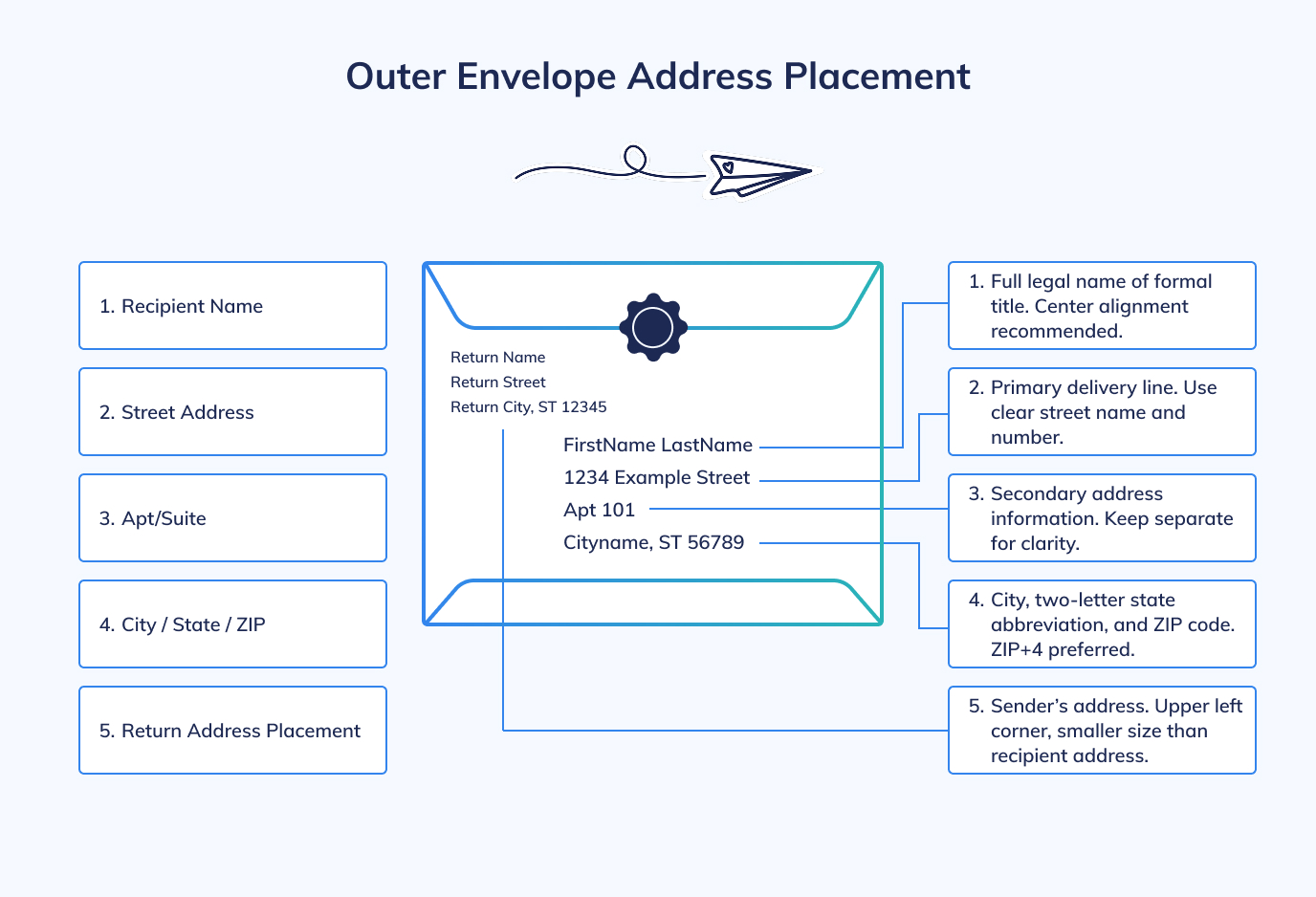
Write the recipient names on the first line, then the complete street address on the second line. If there’s an apartment or suite number, place it on its own line above the street address line. This format follows postal standards and looks polished without extra fuss.
Example:
John and Sarah Johnson
123 Maple Avenue
Chicago, IL 60614
If the home has an apartment or suite number, add it above the street line:
John and Sarah Johnson
Apartment 4B
123 Maple Avenue
Chicago, IL 60614
For a polished look, spell out Street, Avenue, Boulevard, and Drive rather than abbreviating them.
Address Only the People You’re Actually Inviting
List children’s first names beneath their parents’ names when they’re invited to your celebration. If you’re planning an adults-only wedding, address the envelope to the parents only. This approach makes your guest count crystal clear and prevents awkward misunderstandings. According to Emily Post etiquette, the outer envelope should reflect exactly who you want at your wedding, and collecting accurate guest information upfront makes addressing much smoother.
If children are invited:
John and Sarah Johnson
Emma and Noah
If the event is adults-only:
John and Sarah Johnson
Honor the Titles People Actually Use
Include professional titles like “Dr.,” “Judge,” or military ranks when you know someone uses them regularly. If you’re unsure, ask a mutual friend or family member, or simply use their full first and last names without any title. Martha Stewart’s wedding experts recommend matching how people introduce themselves in real life. When in doubt, full names feel warm and personal without risking offense.
 Modern and Informal Options (Without Breaking Etiquette)
Relaxed doesn’t mean rude. You can create a warm, contemporary feel with your addressing while still showing respect for your guests.
- Skip formal titles and use first and last names for a friendly, personal touch on casual or daytime weddings
- Place your wedding website URL on a details card or save-the-date, never directly on the invitation itself
- Skip inner envelopes entirely if your outer envelope clearly shows who’s invited and streamlines your process
- Write “Sarah Jones and Mike Smith” instead of “Sarah Jones & Mike Smith” when listing couples for a softer, more personal feel
- Include your honeymoon registry link on your site where guests can easily find it alongside RSVP details
Informal wording for addressing wedding invitations works beautifully when it matches your celebration’s style. These modern touches create invitations that feel authentic to you while keeping guests informed and ready to celebrate.
Wedding Invitation Addressing Examples for Common Situations
Many couples search for examples because real-life situations can feel confusing. Here are some common addressing scenarios.
Married Couple, Same Last Name
Mr. and Mrs. David Carter
or modern style:
David and Emily Carter
Married Couple, Different Last Names
Emily Carter and David Nguyen
Unmarried Couple Living Together
Sarah Jones and Mike Smith
Family with Children Invited
Michael and Anna Lopez
Lucas and Sofia
Guest with a Plus-One
Rachel Kim and Guest
Doctor or Professional Title
Dr. Hannah Patel and James Rivera
Single Guest
Jordan Blake
Wedding Invitation Etiquette for Guest Communication
Beyond addressing, your invitations should help guests understand the key details of your celebration.
A wedding website often becomes the central place for guests to find:
- RSVP information
- travel details
- schedule of events
- registry links
Keeping these details on your website prevents invitations from becoming cluttered while making it easy for guests to plan.
Common Wedding Invitation Addressing Mistakes
Even organized couples make small addressing mistakes. Avoid these common issues:
- Listing guests who aren’t invited — the envelope should reflect your exact guest list.
- Using nicknames instead of full names — formal invitations typically use full names.
- Including registry details on the invitation — registry information belongs on your wedding website.
- Using inconsistent formatting — keep names and addresses consistent across every invitation.
- Forgetting plus-one wording — writing “and Guest” clarifies when someone can bring a date.
Fixing these small details ensures guests clearly understand your invitation.
FAQ: Children, Plus-Ones, and Registry Etiquette
How do you indicate whether children are invited?
When children are invited, list their first names on a second line beneath their parents’ names on the outer envelope. For adults-only events, address only the parents by name. Never print “no children” on the invitation itself. Your addressing clearly indicates who’s invited, and you can communicate the policy through your wedding website or close family members.
Can you use modern, informal wording and still be polite?
Absolutely. Skipping formal titles and using first and last names creates a warm, personal tone that works beautifully for today’s weddings. The key is consistency across all your invitations. Modern approaches like this show respect through clarity and thoughtfulness, not rigid formality.
How should you handle plus-ones on wedding invitations?
For guests with a plus-one, write “and Guest” after their name on the outer envelope, if you don’t know the guest’s name. If you know both names, list them separately on the envelope. This makes it clear that your guest can bring someone while keeping your addressing clean and respectful.
Where should registry information go for honeymoon or cash registries?
Never put registry details on your wedding invitation. Include your website URL on a separate details card instead. Your site can feature your honeymoon fund and explain your choice tastefully. This keeps your invitation focused on celebrating while giving guests easy access to gift information.
What if you make an addressing mistake after mailing?
Don’t panic. Most guests understand that wedding planning involves many moving pieces. If someone asks about a significant error, apologize briefly and clarify the correct information. For future mailings, double-check your guest list against your envelopes before sealing.
Before You Mail Wedding Invitations: Quick Checklist
Before sealing your invitations, take a few minutes to double-check these details:
✔ Guest names are spelled correctly
✔ Only invited guests appear on each envelope
✔ Titles are accurate where appropriate
✔ Street addresses are complete and readable
✔ Your wedding website appears on a details card
✔ RSVPs and registry links are listed on your website
Taking a final pass helps prevent mistakes and ensures guests receive clear information about your celebration.
Wrap-Up: Make Addressing Invitations Easy
Addressing wedding invitations for a honeymoon or cash registry wedding becomes simple when you follow clear formatting rules and keep guest communication in one place. Your wedding website takes care of RSVPs, your registry, and guest details so guests find everything they need with a single link.
Ready to streamline your wedding planning? Build your cash registry and wedding website in minutes with Honeyfund.